Struggling with slow sales and low traffic can leave any small e-commerce owner in the United States feeling stuck. Knowing exactly where your website stands is the first step to real improvement. A thorough SEO audit is more than a routine check—it acts as a health check, revealing issues that could be blocking your search visibility and hurting user experience. You will discover practical ways to diagnose weaknesses in your site, setting the stage for strategies that actually drive growth.
| Key Point | Explanation |
|---|---|
| 1. Conduct a Comprehensive SEO Audit | Begin by assessing your website’s SEO health to identify strengths, weaknesses, and opportunities for quick wins. |
| 2. Focus on Keyword Research | Target keywords with buying intent and optimize content around them to increase conversion rates. |
| 3. Optimize Site Structure | Ensure a logical site hierarchy for better navigation and crawling effectiveness by search engines. |
| 4. Track Key Performance Metrics | Use tools like Google Analytics to monitor traffic, conversion rates, and user behavior to measure success. |
| 5. Regularly Update Your Content | Maintain relevance by updating content and product descriptions, focusing on user intent to keep engagement high. |
Before you optimize, you need to understand where your site stands right now. Think of this as a diagnostic checkup for your e-commerce business. You’ll identify what’s working, what’s broken, and where quick wins hide.
Start by running a comprehensive SEO audit. This means evaluating your website’s crawl accessibility, technical performance, content quality, and backlink profile. SEO audits act as health checks, identifying issues that impact your visibility in search results and user experience.
Use these free and paid tools to gather data:
Here’s how popular SEO tools differ for e-commerce website audits:
| Tool Name | Main Strength | Best For |
|---|---|---|
| Google Search Console | Index issues | Identifying crawl problems |
| Google PageSpeed Insights | Page speed metrics | Improving mobile experience |
| Semrush or Ahrefs | Backlink monitoring | In-depth technical audits |
| Screaming Frog | Site crawling | Finding broken links |
Focus on these core areas during your assessment:
Look specifically for common issues that tank e-commerce rankings. Slow loading times kill conversions. Mobile-unfriendly designs lose mobile shoppers. Broken links confuse both search engines and customers. Poor navigation makes products hard to find.
Document everything you find during this audit so you can track improvements over time and prioritize fixes by impact.
Once you’ve gathered your baseline data, you’ll know exactly which SEO issues drain your visibility and sales potential. This foundation guides every optimization decision moving forward.
Pro tip: Set up a spreadsheet tracking your key metrics like Core Web Vitals, total indexed pages, and average page speed before you start optimizing, then check these weekly to see if your changes actually move the needle.
Now that you know your site’s health, it’s time to fix and improve your content. This step focuses on matching your pages to what customers actually search for and making sure search engines understand your content.
Start with keyword research tailored to your e-commerce goals. Look for keywords that show buying intent, not just traffic potential. A customer searching “best running shoes under $100” is closer to purchase than someone searching “running shoe history.”
Use these keyword research approaches:
Once you’ve identified your keywords, optimize each page around one main keyword and 2-3 related terms. Strategic keyword placement in titles, headings, and metadata improves how search engines understand your content.
Optimize these on-page elements:
Content optimization improves visibility when your pages answer the specific questions your customers ask. Don’t just target keywords—match the search intent behind them. A customer searching “how to choose running shoes” needs educational content, not a product page.
Update your content regularly and avoid keyword repetition, which confuses search engines and frustrates readers.
Your product descriptions deserve special attention. Generic manufacturer descriptions tank rankings. Write descriptions highlighting benefits your customers care about, using natural language that incorporates your keywords.

Pro tip: Use a keyword density checker to ensure each page targets one primary keyword 1-2% of the time; higher frequencies trigger stuffing penalties and lower your rankings.
Your site structure is the foundation that search engines crawl and customers navigate. A well-organized site helps Google understand your content and helps shoppers find products faster. This step focuses on the technical backbone that supports your SEO efforts.
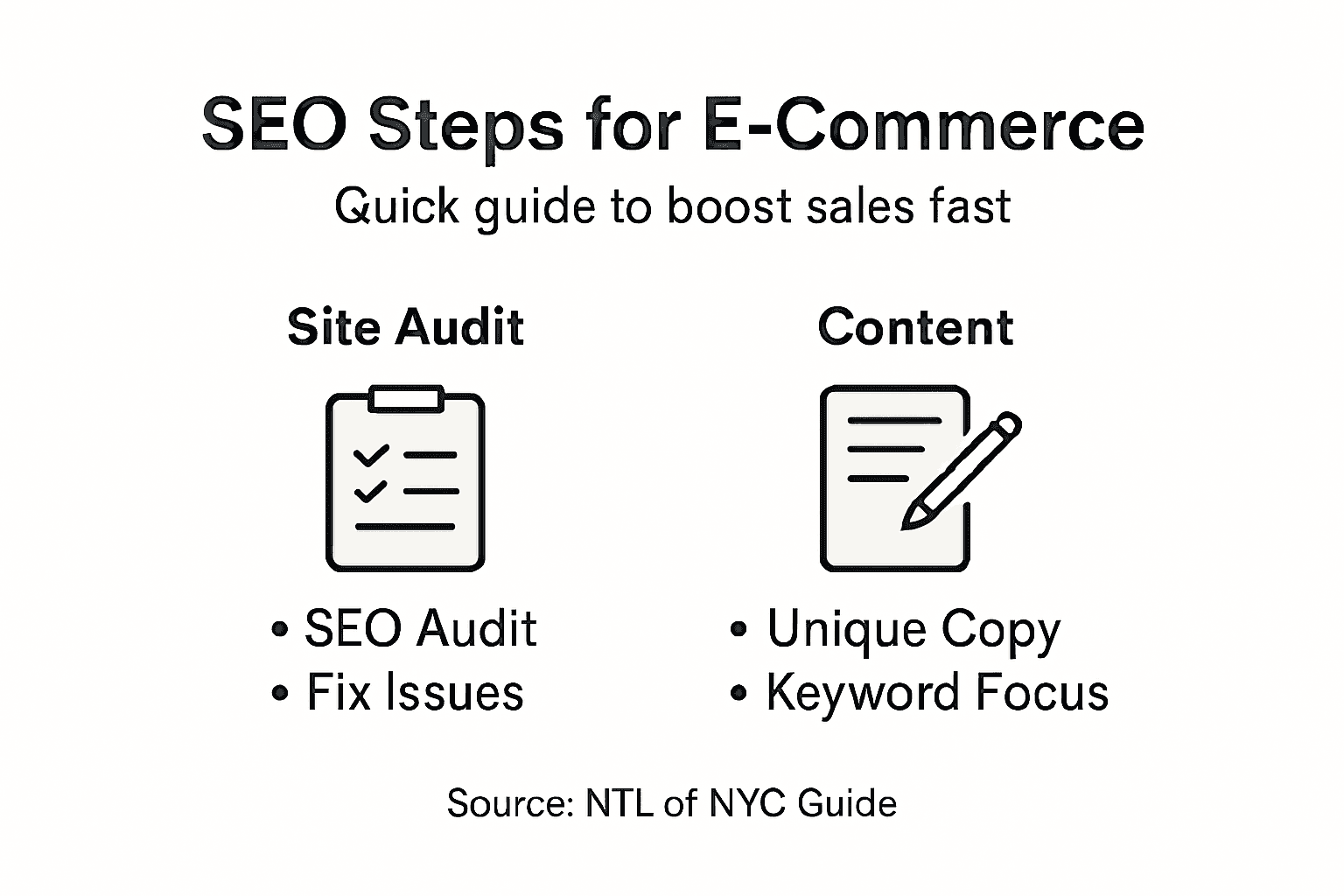
Start by auditing your site architecture. Your structure should flow logically from broad categories to specific products. A clear hierarchy helps both search engines and users understand how pages relate to each other.
Optimize your site structure this way:
Technical SEO optimization requires attention to crawlability and indexability. Search engines need to access and understand your pages. Fix these technical issues first.
Prioritize these technical improvements:
Handle duplicate content carefully. Your e-commerce site likely has product variations and filter pages creating duplicates. Use canonical tags to tell Google which version to prioritize, preventing ranking dilution.
Improve site speed by compressing images, removing unnecessary code, and using a content delivery network; fast sites convert better and rank higher.
Test your site accessibility. Check that search engines can crawl your pages by reviewing Google Search Console’s coverage report. Look for blocked resources, noindex tags, or crawl errors preventing indexing.
Pro tip: Create an XML sitemap listing all your important pages and submit it to Google Search Console; this helps Google discover and index your products faster, especially new listings.
Your SEO work doesn’t end after optimization. You need to track what’s actually working and adjust based on real data. This step teaches you how to measure success and catch problems early.
Set up your tracking tools immediately. Google Analytics 4 and Google Search Console are free and essential for every e-commerce owner. They show you organic traffic, which pages convert, and what keywords drive visitors to your site.
Start monitoring these key performance indicators:
Review this comparison of key SEO performance metrics and what each reveals about your site:
| Metric | What It Measures | Typical Action Triggered |
|---|---|---|
| Organic Traffic | Search engine visitor volume | Adjust content or keywords |
| Conversion Rate | Visitors who buy | Refine offers or landing pages |
| Bounce Rate | Users leaving quickly | Improve page relevance/focus |
| Keyword Rankings | Position for target terms | Update optimization strategy |
Measuring SEO performance involves tracking metrics like impressions, clicks, and conversions to understand what’s driving your business growth. Don’t just look at vanity metrics like total traffic. Focus on conversions and revenue impact.
Create a simple dashboard to track progress:
Effective performance monitoring requires analyzing multiple metrics together, not just one or two. A page might rank well but convert poorly, telling you the traffic quality needs work. Another page might have low traffic but high conversion value, worth more investment.
Set realistic expectations; most sites see meaningful results within 3 to 6 months of consistent optimization, though competitive industries take longer.
Use your data to guide decisions. If a page ranks but doesn’t convert, improve the page experience or product description. If certain keywords drive sales, create more content around those topics. Let data, not guesses, guide your strategy.
Pro tip: Set up Google Search Console alerts for significant ranking drops or indexing issues so you catch problems within hours, not weeks, preventing major traffic loss.
Struggling with slow page speeds or confusing site structure that keeps potential customers from completing purchases? The challenges outlined in the “SEO Optimization Guide to Boost E-Commerce Sales Fast” highlight common pain points like technical SEO hurdles, keyword targeting, and performance tracking that stall your online growth. If you want to stop losing valuable traffic and crush those obstacles, you need a trusted partner to transform these insights into measurable results.
NTL of NYC specializes in providing tailored digital marketing and web development services designed specifically to fix issues like crawlability, site speed, and content optimization. Our comprehensive approach includes strategic SEO improvements, custom website development, and ongoing performance monitoring. We help businesses turn complex SEO concepts into practical actions that boost visibility, increase conversions, and drive sales.
Discover how our SEO services can power your e-commerce success with tailored strategies.

Ready to stop guessing and start winning? Visit NTL of NYC today to schedule a consultation and take the first step toward a faster, smarter, and more profitable e-commerce website. Your growth starts with the right partner now.
To assess your website’s SEO health, run a comprehensive SEO audit focusing on crawl accessibility, technical performance, content quality, and backlink profile. Use free and paid tools to gather data and identify issues impacting visibility and user experience, then document your findings to prioritize fixes.
To optimize your content and keywords, conduct keyword research targeting long-tail keywords that demonstrate buying intent. Focus on placing your main keyword in key on-page elements such as title tags, meta descriptions, and headers to enhance search visibility and better serve user intent.
Improve your site structure by creating a clear navigation menu and utilizing breadcrumb navigation, making it easy for users to find products. Additionally, prioritize technical SEO elements like site speed, mobile responsiveness, and a clean URL structure, which can help boost search rankings and improve user experience.
To verify your SEO results, monitor key metrics such as organic traffic, conversion rate, and bounce rate. Regularly reviewing these indicators will help you understand what’s working and allow you to adjust your strategy for optimal performance.
Typically, most websites see meaningful SEO results within 3 to 6 months of consistent optimization efforts. Set realistic expectations and keep track of your progress regularly to adjust your strategy as needed effectively.
Article generated by BabyLoveGrowth
Many small businesses spend months wondering why their websites barely show up on Google, despite endless tweaks and updates. Understanding what Search Engine Optimization really means can change everything. When you learn how search engines actually crawl, index, and rank your site, you see why simply stuffing keywords or ignoring technical issues falls short. This article brings clarity to common SEO myths and explains the key elements that drive real search visibility for North American entrepreneurs.
| Point | Details |
|---|---|
| Understanding SEO | SEO is essential for enhancing your website’s visibility and attracting organic traffic, requiring ongoing optimization efforts. |
| Components of SEO | Focus on the three main components: On-page, Off-page, and Technical SEO, to create a comprehensive strategy. |
| Common Myths | Many believe SEO yields immediate results, but effective optimization typically takes 3-6 months of consistent effort. |
| Investing in SEO | Realistic expectations regarding time and financial investment are crucial, as SEO requires a sustained commitment for success. |
SEO stands for Search Engine Optimization, a set of practices that improves your website’s visibility when people search for products or services you offer. At its core, SEO is the process of making your website more visible in search results by following the rules that search engines like Google use to rank websites.
Here’s what actually happens: Search engines send out automated “crawlers” that follow links from page to page, reading and indexing your content. When someone searches for a term, the engine displays the most relevant indexed pages. If your website follows the right practices, you have a better chance of showing up in those top results, driving more visitors to your site.
For a small e-commerce business or local service provider, SEO directly impacts your bottom line. More visibility means more traffic. More traffic means more potential customers finding you organically, without paying for ads.
SEO involves three main components:
Think of it like this: On-page SEO is telling Google what your page is about. Technical SEO is making sure your site runs smoothly so Google can crawl it. Off-page SEO is other websites vouching for your credibility.
SEO isn’t a one-time fix—it’s an ongoing process that requires consistent effort and optimization.
Most small business owners believe at least one myth about SEO. Let’s break down the biggest ones.
Myth 1: “SEO is dead because Google keeps changing.” Reality: Google updates its algorithm regularly, but the fundamentals don’t change. Google wants to show relevant, high-quality content to users. That hasn’t changed in 20 years.
Myth 2: “I’ll rank for everything if I use the right keywords.” Reality: You compete with thousands of other websites. Ranking depends on relevance, authority, and user experience—not just keyword stuffing.
Myth 3: “SEO results happen overnight.” Reality: Most websites see meaningful results in 3-6 months. This frustrates small business owners accustomed to faster marketing results, but sustainable ranking requires time.
Myth 4: “I can ignore SEO if I do paid ads.” Reality: Paid ads stop the moment you stop paying. Organic search results compound over time. A combination of both works best.
Myth 5: “More keywords on a page = higher rankings.” Reality: Keyword stuffing hurts your rankings. Modern SEO rewards natural, valuable content that answers user questions.
When planning your strategy, understanding the difference between vanity metrics and actual ROI helps you focus on what actually moves your business forward.
Pro tip: Don’t chase rankings for their own sake. Instead, focus on ranking for search terms that match your ideal customer’s intent—the words they use when ready to buy or hire.
SEO breaks down into three main types, each targeting different aspects of how search engines find and rank your website. Understanding these distinctions helps you build a balanced strategy instead of focusing on just one area and leaving gaps in your visibility.

On-page SEO focuses on optimizing the content and structure of individual web pages on your website. This is everything you control directly on your own site.
On-page elements include:
Think of on-page SEO as the foundation. If your content doesn’t clearly explain what your business offers, no amount of technical fixes will help.
Off-page SEO involves building your website’s authority and credibility outside your own site. This signals to search engines that other websites trust and recommend you.
Off-page tactics include:
Backlinks act like digital votes of confidence. If a trusted website links to yours, Google interprets that as validation.
Technical SEO ensures your website’s behind-the-scenes structure allows search engines to crawl, index, and understand your content efficiently. Technical SEO involves semantic HTML tagging and site crawlability so crawlers can properly analyze every page.
Technical aspects include:
The best content in the world won’t rank if search engines can’t crawl and index your website effectively.
These three types aren’t separate strategies—they’re interconnected. Strong on-page content attracts backlinks (off-page). A technically sound site ensures those backlinks actually help your rankings. Following SEO best practices across all three types creates a comprehensive optimization strategy that compounds over time.
Small business owners often neglect one area. Some focus only on content. Others obsess over keywords but ignore mobile speed. The winners address all three.
Pro tip: Start with on-page SEO first—fix your content and structure. Then tackle technical issues. Finally, build off-page authority through strategic partnerships and relationship-building.
Here’s a comparison of the three main types of SEO and their unique focus areas:
| SEO Type | Primary Focus | Key Outcome |
|---|---|---|
| On-Page SEO | Content and structure optimization | Improved keyword targeting and clarity |
| Off-Page SEO | Building online authority | Enhanced credibility through backlinks |
| Technical SEO | Website infrastructure and crawlability | Increased search engine accessibility |
SEO success depends on understanding three core processes that search engines use to discover, organize, and display your website. Without knowing how these work, you’re essentially guessing at what might help your rankings.
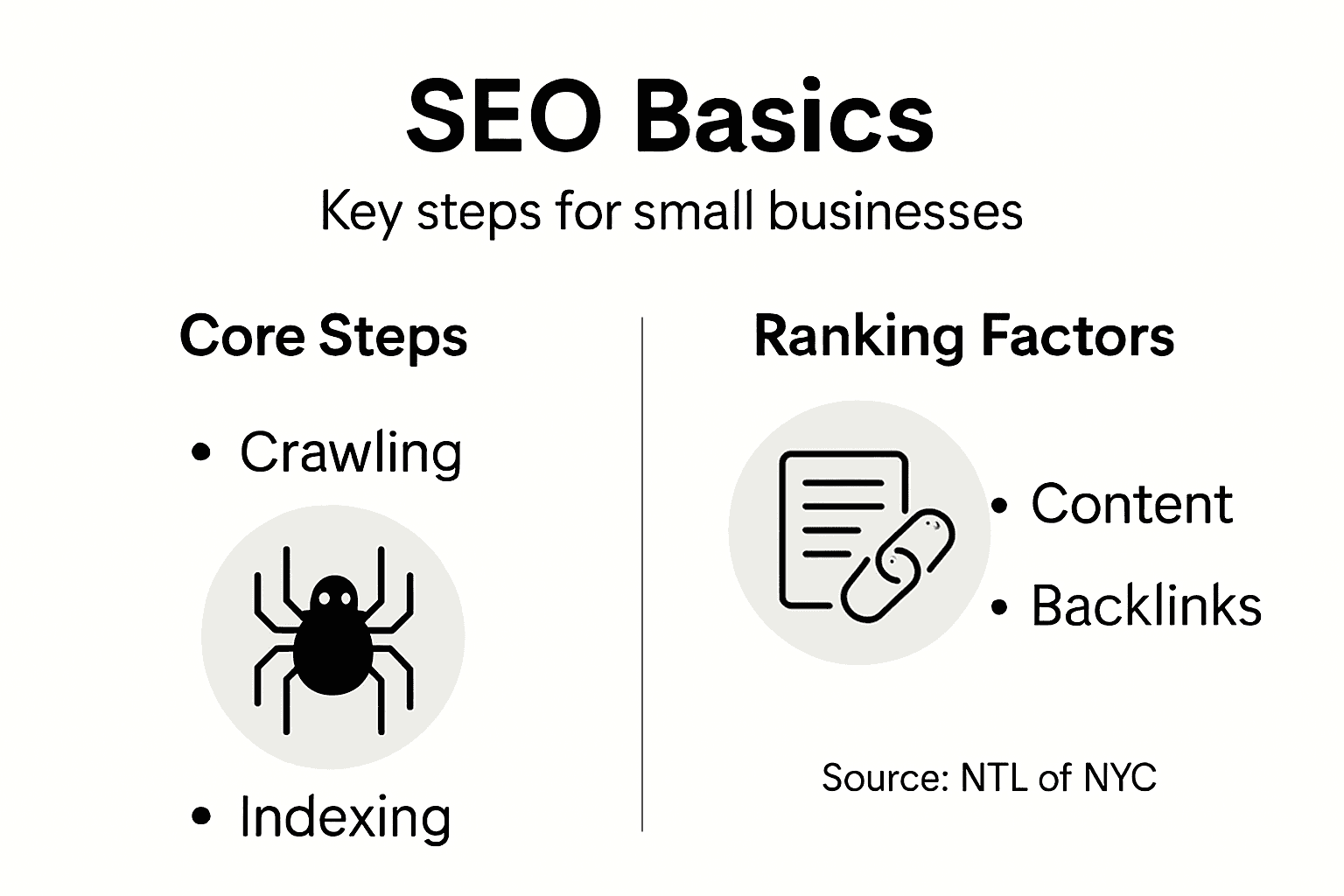
Crawling is how search engines discover your website and new or updated pages on it. Think of crawlers as automated robots that follow links across the web, visiting page after page.
Here’s what happens:
Not all pages get crawled equally. Search engines prioritize based on:
A slow website with poor structure wastes your crawl budget. Crawlers might not even find all your pages.
Indexing is when search engines analyze the pages they’ve crawled and store them in their database. Search engine bots analyze discovered pages and store content in the search engine’s database for later retrieval.
During indexing, Google determines:
Not every crawled page gets indexed. Pages with thin content, duplicate issues, or poor user experience often get excluded. This is why many business owners are shocked their website pages don’t appear in search results—they were crawled but not indexed.
Ranking is where search engines order results based on relevance and quality. Ranking algorithms evaluate relevance, authority, and user experience signals to order search results.
Google considers hundreds of factors, including:
You can’t rank for what search engines haven’t indexed, and they can’t index what they can’t crawl.
Many small business owners optimize for ranking without fixing crawlability or indexability first. That’s backwards. If your site isn’t crawlable, optimization is pointless.
The three processes are sequential. A problem at any stage prevents success at the next. Slow site speed kills crawling. Poor indexing means no ranking. Bad ranking means no traffic.
Pro tip: Submit your XML sitemap to Google Search Console and monitor the “Coverage” report to ensure all your pages are being crawled and indexed, not blocked or excluded.
Google uses hundreds of signals to rank websites, but not all factors matter equally. Understanding which ones drive results helps you prioritize your efforts and avoid wasting time on tactics that won’t move the needle.
Content relevance remains the foundation of ranking. Your page must answer the question someone is searching for, not just contain the keyword.
Content factors include:
A 500-word article that actually answers a question beats a 5,000-word article filled with fluff. Google rewards specificity and usefulness, not word count.
Your website’s technical health directly impacts rankings. Website ranking depends on factors including site speed, mobile-friendliness, crawlability, and secure architecture.
Technical ranking factors include:
A beautifully designed site that takes 8 seconds to load will lose rankings to a plain site that loads in 2 seconds.
Backlinks signal that other websites trust yours. Not all links are equal—quality matters far more than quantity.
Backlink factors include:
One high-quality backlink from an industry authority beats 100 low-quality links from random websites.
Google monitors how visitors interact with your pages. Pages that keep visitors engaged rank better than pages people quickly abandon.
Engagement metrics include:
These signals tell Google whether your page actually satisfies what searchers are looking for.
For local businesses, location-specific ranking factors significantly influence visibility in local search results.
Additional factors include:
Ranking factors work together. Fixing one factor without addressing others limits your results.
Pro tip: Audit your top 10 competitors for each keyword you target. Note which factors they excel at—content depth, backlink count, page speed—then develop a strategy that matches or exceeds their strongest areas.
Below is a summary of major SEO ranking factor categories and how they influence website performance:
| Factor Category | Main Influence | Typical Impact |
|---|---|---|
| Content Quality | Answers user intent | Higher relevance and rankings |
| Technical Performance | Site speed, mobile usability | Better crawl and user experience |
| Backlink Authority | External trust signals | Greater domain credibility |
| User Engagement | Visitor actions and time | Signals content usefulness |
| Local/Domain Factors | Location and domain history | Better local visibility |
SEO requires investment—both in time and money. Understanding the real costs and common pitfalls helps you avoid expensive mistakes and set realistic expectations for your business.
Many small business owners expect SEO results within weeks. That’s not how it works. SEO is a long-term strategy that typically takes 3-6 months to show meaningful results, depending on competition and your starting point.
This timeline frustration leads to a critical mistake:
Businesses that stick with SEO for 6-12 months typically see compounding results that accelerate over time. Those who quit early see nothing.
SEO isn’t free, even though you’re not paying per click like with ads. Realistic costs include:
Small businesses often start with just content creation and basic optimization. As they scale, they invest in professional help. The key is starting with what you can afford and building from there.
Keyword stuffing and over-optimization remains one of the biggest errors. Cramming keywords into your content in unnatural ways triggers Google penalties instead of rankings.
Other frequent mistakes include:
One well-researched piece of content beats 10 poorly researched articles that nobody links to or finds.
SEO poisoning is a cybersecurity threat where attackers manipulate search optimization techniques to promote malicious sites. Protecting your website requires robust security practices.
Ethical and security considerations:
You don’t need an agency day one, but certain situations justify professional investment. Understanding your SEO strategy’s ROI helps determine when professional services make financial sense.
Consider hiring help when:
Pro tip: Start by documenting your current rankings, traffic, and conversions for key keywords. After 6 months of effort, compare these metrics to your baseline. If you’re not moving forward, that’s when to invest in professional guidance rather than continuing the same approach.
Understanding the challenges of SEO—from crawling and indexing to ranking—can feel overwhelming for any small business owner. If you have experienced frustration with slow results or unclear strategies, you are not alone. The key pain points like keyword confusion, technical hurdles, and the need for consistent content optimization require expert guidance and a comprehensive approach. At NTL of NYC, we specialize in bridging these exact gaps by offering custom solutions tailored to your business goals. We focus on on-page optimization, technical SEO fixes, and authoritative link-building strategies that drive real, measurable growth.
Don’t let the complexity of SEO stall your growth. Visit NTL of NYC to discover how our full-service digital marketing and web development agency helps businesses like yours rank higher, attract more visitors, and convert leads into loyal customers. Ready to transform your online presence with proven SEO strategies? Explore our custom website development and search engine optimization services today. Take action now to build the solid foundation your business deserves.
SEO, or Search Engine Optimization, is a set of practices that improve your website’s visibility in search results. For small businesses, effective SEO means more visibility, leading to increased organic traffic and potential customers without the need for paid advertising.
Typically, SEO can take 3-6 months to show meaningful results. This timeline can vary based on competition and the current state of your website, but patience is essential for sustainable ranking improvements.
SEO consists of three main components: On-page SEO, which focuses on optimizing content and structure; Off-page SEO, which builds authority through backlinks; and Technical SEO, which ensures your website’s infrastructure meets search engine standards.
Technical SEO is crucial because it ensures search engines can crawl, index, and understand your website effectively. If search engines can’t access your content due to technical issues, you won’t rank in search results, no matter how great your content is.