Service

Analytics & Paid Media

GA4 that actually tells you what is working — and paid ads that do not quietly burn budget on the wrong audience.

Analyst reviewing performance dashboards and advertising charts on dual monitors — analytics and paid media by NTL of NYC.
GA4 done right and ROAS-positive ad management.
2007In business since
100sof small businesses ranked
6Global offices, one accountable team
Why this matters

The problem we solve

GA4 is misconfigured on 80% of the sites we audit. "Conversions" are pageviews, not actual conversions. Form submissions are not firing. Phone clicks are not tracked. Cross-domain measurement is broken. E-commerce events are double-firing or missing entirely. The dashboard says "leads are up 12%" but the business knows that is not true — and nobody trusts the numbers enough to make a real decision from them.

Paid ads are usually worse. Broad-match keywords burning budget on irrelevant clicks. No negative keywords. Ad accounts running on autopilot with no recent optimization. Audience targeting set up two years ago and never revisited. Attribution windows lying about which channel actually drove the conversion. Most small-business paid media accounts we audit have 30-50% wasted spend hiding in plain sight — money the business could be reinvesting in the channels that actually work.

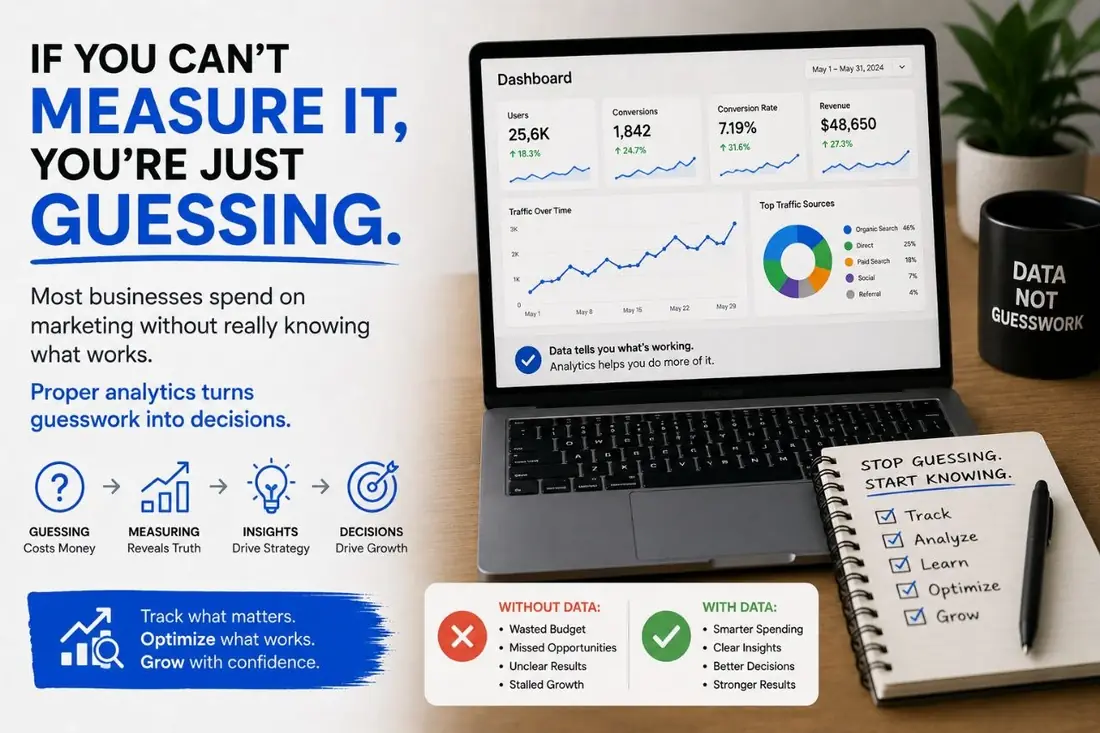
Our analytics + paid media work is one bundled service for a reason: you cannot manage what you cannot measure, and you cannot honestly spend on paid media until you can measure what is working. We rebuild the GA4 foundation first, then run paid media on top of accurate data.

Quick read

Want a free audit of where your business stands right now?

30-minute call. We'll look at your site, your search visibility, and tell you the 2-3 highest-leverage moves.

How we work

Our approach

A repeatable playbook refined across hundreds of small-business engagements since 2007.

  1. 1

    Audit — GA4, GTM, ad accounts, attribution

    Two-week audit of the entire measurement stack: GA4 property setup, GTM container, conversion events, e-commerce events, custom dimensions, audience definitions, Google Ads and Meta Ads accounts, attribution models, and the connections between all of them. Output: a written diagnostic listing what is broken, what is missing, what is misconfigured, and what is genuinely working.

  2. 2

    GA4 rebuild — events, conversions, e-commerce

    Reconfigure GA4 from the ground up. Properly tagged events (not just pageviews). Conversion events that match real business outcomes (qualified leads, purchases, calls — not "user scrolled 50%"). E-commerce events properly mapped on stores. Custom dimensions for segments your business actually cares about. Reports built around the questions you actually ask, not the default Google template.

  3. 3

    Server-side tagging — accurate measurement after iOS/ITP

    Server-side GTM container (using Stape, Google Cloud Run, or similar). Browser-side tracking has been increasingly degraded by iOS Mail Privacy Protection, Safari ITP, Chrome's third-party cookie deprecation, and ad blockers. Server-side captures what client-side now misses — typically 15-30% of conversions that were silently lost. This single change is often the highest-impact item in the entire audit.

  4. 4

    Paid ads — Google, Meta, and where else makes sense

    Google Ads (Search, Performance Max, Local Services Ads where applicable) and Meta Ads (Facebook, Instagram, occasionally Threads) built around accurate conversion data. Negative-keyword lists pruned aggressively. Audience targeting refined monthly. Creative testing on Meta. Branded vs non-branded budget split optimized continuously. Microsoft Ads where the demographic justifies it (often older, more affluent, higher-conversion audiences).

  5. 5

    Monthly attribution + optimization

    Monthly report covering: spend by channel, leads by channel, revenue by channel (where attribution allows), cost-per-lead and cost-per-acquisition trends, what changed in the last month and why. Optimization decisions made on this data: reallocate budget to what is working, kill what is not, test new creative or new audiences.

Scope

What's included

Every engagement covers the work below — adjusted to where your business actually is.

  • Full GA4 audit and rebuild (events, conversions, custom dimensions, audiences)
  • GTM container setup or remediation, with documented tag inventory
  • Server-side GTM configuration (Stape, Google Cloud Run, or hosted)
  • E-commerce event tracking for Shopify, WooCommerce, or custom platforms
  • Phone-call tracking (CallRail or equivalent) where applicable
  • Cross-domain measurement for sites with multiple properties
  • Google Ads account setup or audit + ongoing management
  • Meta Ads account setup or audit + ongoing management
  • Microsoft Ads where the audience justifies it
  • Negative-keyword and audience hygiene (monthly pruning)
  • Creative testing on Meta (image, video, copy variants)
  • Monthly attribution report tied to revenue (where available) and lead volume
Industries

Built for businesses like yours

We tailor every engagement to the specifics of your vertical — same playbook, different application.

FAQ

Common questions

GA4 vs Universal Analytics — what changed and what still works?
Universal Analytics was sunsetted July 2023. GA4 is the only Google Analytics now. It is an event-based model (everything is an event, including pageviews) rather than the session-based model UA used. Most of what people miss about UA is muscle memory — the reports they were used to. GA4 has the same data, often more, but it is reported differently. We rebuild the reports you actually need so the platform stops being a frustrating tool.
Why server-side tagging? Is it really worth the cost?
Yes, almost always. Browser-side tracking is increasingly broken: Safari's ITP truncates 1st-party cookies after 7 days, ad blockers strip GA entirely (15-25% of users on many sites), iOS Mail Privacy Protection inflates open rates and breaks email-to-site attribution, and Chrome is phasing out third-party cookies. Server-side captures conversion data even when client-side does not. We typically recover 15-30% of "missing" conversions with this change alone. The infrastructure cost is $20-100/month depending on volume, which is rounding error against the spend it informs.
What budget do we need for paid ads to be worth it?
Honest minimums: $1,500-$2,500/month spend before paid ads are worth managing actively. Below that, the management overhead eats too much of the budget. Above that, every $1,000 of monthly spend should be measurable in leads or revenue. We are honest with prospects when their budget is too low — we will tell you to invest that money in SEO or content first, and come back to paid when the budget can sustain real optimization.
How do you split budget between Google and Meta?
Depends on the business. Service businesses where customers actively search for what you offer (movers, plumbers, lawyers, restaurants when people are hungry now): Google heavy, Meta supplementary. Lifestyle / discovery brands where customers do not yet know they want what you have (apparel, decor, novel products): Meta heavy, Google for branded protection. E-commerce: usually both, with budget split refined monthly based on which is actually returning. We start with a hypothesis and let the data correct us.
What is a healthy cost-per-lead or cost-per-acquisition?
Depends entirely on the customer lifetime value of your business. A moving company where the average job is $3,500 can pay $80-150 per lead profitably. A SaaS business where the average customer is worth $400/month can pay $200-400. A restaurant where the average new customer adds maybe $150 of LTV cannot pay more than $20-30 per lead. We start by establishing what your actual LTV is (most businesses do not know precisely), and then work backwards to a sustainable CPL or CPA. Without knowing LTV, "is this CPL good?" is unanswerable.
Do you ever recommend stopping paid ads entirely?
Yes — and we have. When paid is not returning, when the budget cannot sustain real optimization, when the underlying website conversion rate is broken (and paid traffic is making the leak worse, not better), or when the business is at a stage where investing in SEO and content compounds better. Honest counsel includes telling you when to stop spending, not just helping you spend more.

Ready to see what analytics could do for your business?

Free 30-minute consultation. We'll look at where you are, tell you straight if we're the right team, and give you a candid read on what would actually move the needle.