
Service

E-commerce

Shopify, WooCommerce, and headless stores built to sell more — not just to look good on the home page.

Small-business owner packing online-order boxes beside a laptop showing a storefront — e-commerce websites and growth by NTL of NYC.
Shopify and WooCommerce stores built to sell.
2007In business since
100sof small businesses ranked
6Global offices, one accountable team
Why this matters

The problem we solve

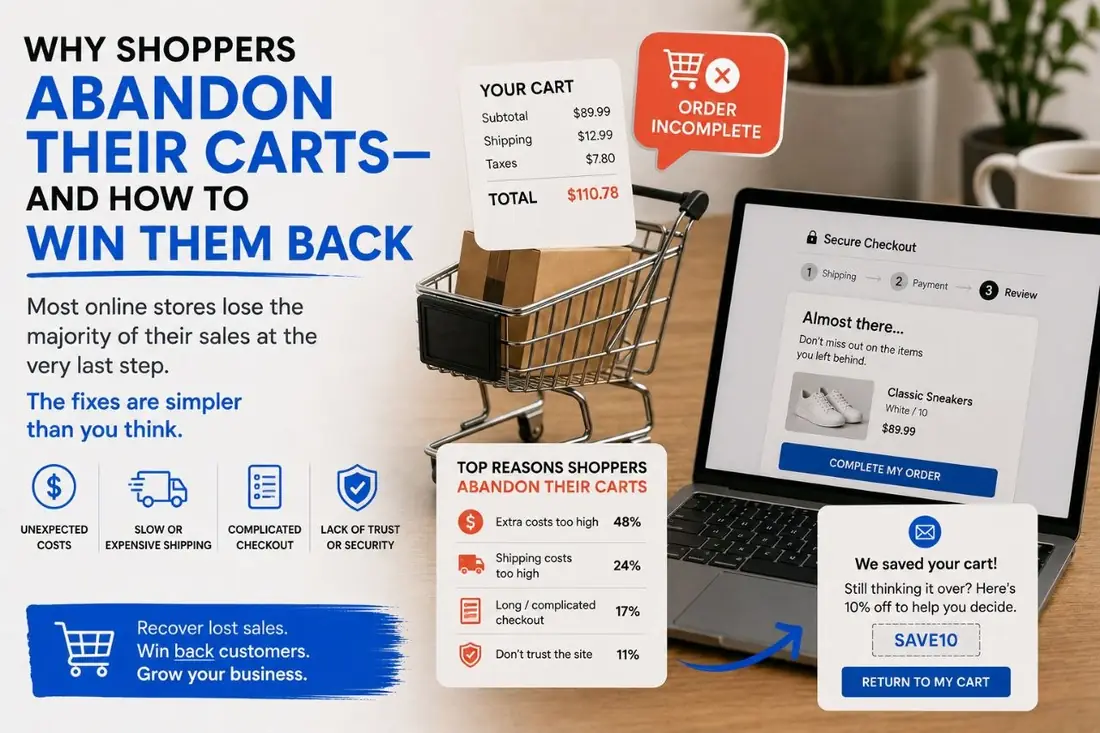
Most e-commerce stores get traffic and still bleed money. The slow product detail page that takes four seconds to render. The mobile checkout that requires zooming. The cart abandonment flow that sends one half-hearted email three days later. The product schema that is missing or wrong, so Google never shows the rich result. The GA4 setup that reports "purchases" but cannot actually be reconciled with what the platform reports because the events are double-firing.

Conversion-rate optimization on a small store is worth more than another month of paid ads — and the work is the same regardless of platform. Speed the product pages. Fix the schema. Simplify the checkout. Wire up real abandoned-cart recovery. Build the post-purchase email flow that drives repeat orders. Make the analytics work so you can finally answer "which channel actually paid for itself?"

We have built and rebuilt stores on Shopify, WooCommerce, BigCommerce, and headless setups (Next.js + Shopify Storefront, Sanity + Stripe) across food, fashion, home goods, B2B, and direct-to-consumer brands. The patterns of what moves AOV, conversion rate, and lifetime value transfer across platforms — and we apply them store by store.
Quick read

Want a free audit of where your business stands right now?

30-minute call. We'll look at your site, your search visibility, and tell you the 2-3 highest-leverage moves.

How we work

Our approach

A repeatable playbook refined across hundreds of small-business engagements since 2007.

  1. 1

    Audit — where revenue is actually leaking

    Two-week audit of the current store (or planned launch). PDP speed analysis, checkout step-through, cart-abandonment review, mobile UX walk-through, product-schema validation, and a GA4 e-commerce audit. Output is a prioritized fix list with revenue-impact estimates per item — so the work is sequenced by what moves the most money first.

  2. 2

    Platform decision — Shopify, Woo, or headless

    Shopify wins for most direct-to-consumer brands: fast, hosted, ecosystem covers 90% of needs. WooCommerce wins when the business has unusual flexibility requirements or already lives in WordPress. Headless wins for stores that need custom storefronts, ultra-fast performance, or B2B-style complex catalogs. We make this call honestly — not based on which we like to build.

  3. 3

    Build — product pages, cart, checkout, recovery

    Product detail pages designed around the conversion psychology of the category (food vs apparel vs B2B looks very different). Cart and checkout simplified to fewest possible steps. Cart-abandonment recovery wired up (email + SMS in some cases) with timing based on actual customer behavior, not the template default. Post-purchase email flow set up for review requests, repeat orders, and lifetime-value compounding.

  4. 4

    Conversion optimization — the boring iterative work

    Post-launch (or in parallel with launch for migrations): A/B testing on PDPs, checkout micro-optimizations, persuasion-copy tweaks, social-proof placement, mobile-specific UX fixes. Small changes that each lift conversion by 0.5-2% — which compounds to meaningful revenue over a year.

  5. 5

    Scale — paid media, email, SEO working together

    Once the foundation converts well, scaling is mostly about acquisition: paid ads (Google Shopping, Meta), email marketing automation that drives repeat purchases, and SEO for the long tail of product-name and category searches. We coordinate all three so they reinforce each other instead of competing for the same budget.

Scope

What's included

Every engagement covers the work below — adjusted to where your business actually is.

  • Full e-commerce audit (PDP speed, checkout, abandonment, schema, analytics) — written report with prioritized fixes
  • Platform recommendation (Shopify, WooCommerce, or headless) with honest trade-off analysis
  • Custom theme development or theme customization (not generic theme installs)
  • Product detail page (PDP) optimization — speed, copy, social proof, cross-sell placement
  • Streamlined checkout with abandoned-cart recovery (email + SMS where applicable)
  • Product schema markup implementation (Product, Offer, AggregateRating, Review)
  • Mobile-first checkout flow with one-page or accelerated checkout where supported
  • GA4 e-commerce setup with proper event mapping (view_item, add_to_cart, begin_checkout, purchase)
  • Email automation flows: welcome, abandoned cart, post-purchase, win-back, review request
  • Inventory, fulfillment, and shipping integration (USPS, UPS, FedEx, ShipStation, ShipBob)
  • Multi-currency, multi-region, and international tax configuration where applicable
  • Post-launch CRO sprints — A/B testing and iterative conversion improvements
Industries

Built for businesses like yours

We tailor every engagement to the specifics of your vertical — same playbook, different application.

FAQ

Common questions

Shopify vs WooCommerce — which should we use?
Shopify is the right answer for 70% of small e-commerce: hosted, fast, secure, and the ecosystem covers almost everything you need. WooCommerce is right when you already live in WordPress and want commerce as one piece of a larger site, or when you need unusual flexibility (custom B2B pricing, complex subscription logic) that Shopify cannot do without expensive apps. Both are great when used for what they are best at — we have built dozens of each.
Can you customize the checkout, or do we use the default?
Shopify Plus customers can fully customize checkout. Standard Shopify customers can customize it within Shopify's constraints (which became significantly more flexible in 2024). WooCommerce gives full control out of the box. We always recommend simplifying first — most checkouts have too many fields, not too few — but yes, we can custom-build it on platforms that allow it.
When is headless e-commerce worth it?
Headless makes sense when you need (1) custom storefront UX that the standard platform cannot deliver, (2) extremely fast PDP performance for SEO and ads, or (3) a single backend serving multiple frontends (e.g. retail kiosks plus web). For most stores doing under $5M annual revenue, headless adds complexity without a proportional return. We are honest about this and have talked clients out of headless when it was wrong for them.
How do you handle platform migrations?
Migrations are one of the higher-risk e-commerce projects because URLs, SEO equity, customer data, order history, and product catalogs all have to come through clean. We follow a documented checklist: full data export and integrity check, URL redirect map (every old URL maps to a new one), schema and meta data carry-over, SEO traffic monitoring for 90 days post-migration, and a rollback plan in case something is wrong. Done right, you do not lose ranking or revenue during the transition.
What about abandoned-cart recovery — is it really worth it?
Yes — abandoned-cart recovery typically recovers 8-15% of abandoned carts when set up properly. The cost is essentially zero (you already have the email address), and the lift is pure margin. Most stores either do not have it set up at all, or have a generic "you forgot something" email going out 24 hours later. Timing matters (first email at 1 hour, second at 24 hours, third at 72 hours with a small discount usually works best) and copy matters more than design.
Can you also run our Google Shopping ads and Meta ads?
Yes — see our Analytics & Paid Media service. For e-commerce specifically, we tie ad spend to actual GA4 e-commerce events and revenue, not just clicks. Most stores are paying for traffic that is not converting because the attribution is wrong; getting that right usually frees up 20-40% of the budget for the channels that actually work.

Ready to see what e-commerce could do for your business?

Free 30-minute consultation. We'll look at where you are, tell you straight if we're the right team, and give you a candid read on what would actually move the needle.