





















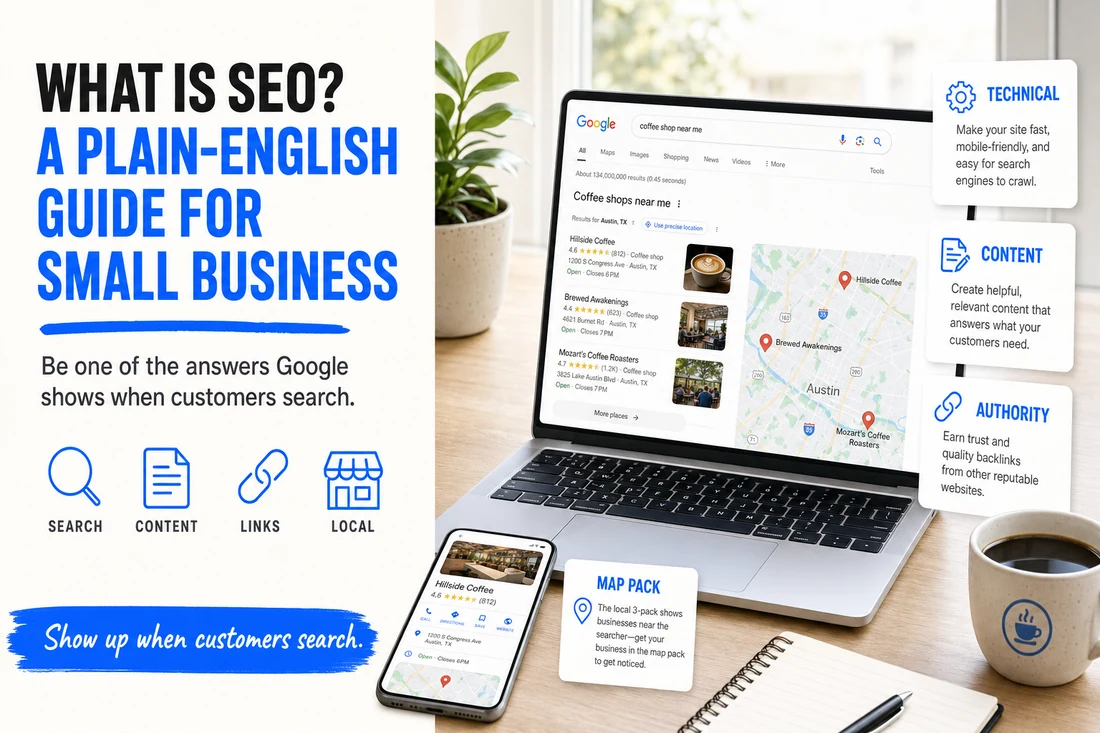

For two decades, SEO meant pleasing one reader: the search engine. Now your content has a second audience that matters just as much — the large language models behind ChatGPT, Gemini, Copilot, and Google's AI answers. The encouraging part is that they reward many of the same things. Write genuinely well-structured, authoritative, machine-readable content and you win in both places at once. Here are the practices that do double duty.
- SEO now has two readers: search engines and the LLMs behind ChatGPT, Gemini and AI answers.
- They reward the same things — answer-first writing, clean structure, real authority, schema.
- Answer-first paragraphs win featured snippets and are exactly what AI quotes.
- Writing for AI does not hurt rankings — the two reinforce each other.
Practices that serve both Google and AI
| Practice | Wins in search | Wins with AI |
|---|---|---|
| Answer-first writing | Featured snippets | The line an AI lifts to quote you |
| Clean H1–H3 structure | Crawlable outline | Easy to parse and cite |
| Topical depth + clear entities | Topical authority | Models map your business correctly |
| Schema markup | Rich results | High-confidence machine signals |
| E-E-A-T signals | Higher rankings | More likely to be cited |
Write for the question, and answer it directly
Both crawlers and LLMs are trying to match content to a real question. Lead each section with a clear, direct answer, then support it. The "answer-first" paragraph is what ranks for featured snippets and what an AI lifts when it generates a response. Bury the answer and you lose both.
Structure so machines can parse you
A clean H1–H3 hierarchy, short paragraphs, bullet lists, and descriptive subheadings give both Google and a language model an unambiguous outline of your page. Models in particular pull cleanly from well-segmented content; a wall of text is hard to cite.
Build semantic depth and entity clarity
Cover a topic completely — the main question and its natural sub-questions — so you demonstrate topical authority rather than keyword presence. Be explicit about the entities involved (your brand, your services, the places you serve) so models can map you correctly instead of guessing.
Mark it up with schema
Structured data (Organization, Service, FAQPage, Article) is the most reliable way to tell machines what your content is. It powers rich results in search and gives AI parsers high-confidence signals about your business and its offerings.
Earn trust the E-E-A-T way
Experience, expertise, authoritativeness, and trust separate content that gets cited from content that gets ignored. First-hand insight, real data, clear authorship, and citations from credible sources all raise your standing with Google and with the models that increasingly weigh the same signals.
Keep the technical foundation clean
Fast pages, accessible HTML, strong Core Web Vitals, canonical tags, sensible internal linking, and a current sitemap make your content easy to crawl, index, and parse. None of the above matters if machines can't reliably read the page.
What to stop doing
Keyword stuffing, thin pages built to chase a single phrase, and content with no point of view are now actively counterproductive. Models reward helpfulness and penalize filler, and Google has spent years moving the same direction.
Common questions
Is "SEO for LLMs" a separate discipline? Increasingly less so. The fundamentals overlap heavily — clear answers, strong structure, real authority, clean schema. AI visibility is the modern extension of good SEO, not a replacement for it.
Will writing for AI hurt my Google rankings? No. The practices that make content quotable to an LLM are the same ones that make it rank — they reinforce each other.
Where do I start with SEO for AI? Audit your top pages for answer-first structure, schema coverage, and topical depth. Fix those three and you improve in both channels at once.