















The AI conversation in 2026 is dominated by impressive demos that have not yet figured out how to be useful. Image generators that produce art nobody asked for. Chatbots that hallucinate. Avatars that talk like awkward stock footage. None of it touches the real bottleneck in most small businesses: too few hours in the day to do the unglamorous repetitive work.
The AI that pays for itself does not get demoed at conferences. It runs quietly in the background, doing one small thing well, and giving the team back hours they would otherwise burn. Here are five that NTL of NYC builds for clients all the time.
- The AI that pays for itself is invisible to customers — it removes repetitive internal work.
- Biggest early wins: lead enrichment, inbox triage, and meeting-notes-to-CRM.
- Most builds need no new tools and no retraining for your team.
- If a task repeats daily or weekly, there is usually a build that pays for itself in month one.
Five boring-AI builds and what they save
| Build | What it does | Time saved |
|---|---|---|
| Lead enrichment on form submit | Briefs the rep before they reply | 8–12 min per lead |
| Inbox triage + draft replies | Auto-drafts the recurring 70% of tickets | 2–3× CS volume |
| Meeting notes to CRM | Extracts next steps and details from transcripts | Write-up time per call |
| Repeated reporting | Pulls data, writes the narrative, sends on schedule | ~1 hr/week, permanently |
| Proposal first drafts | Generates the 80% boilerplate instantly | 2 days → under 2 hours |
1. Lead enrichment on form submit
A new contact form arrives. Before it ever hits a human inbox, an automation looks up the email's domain, fetches the company's website, summarizes what the company does, finds the contact's LinkedIn, and writes a 4-line briefing at the top of the email the sales rep opens. Result: the rep's first response is informed instead of generic. Average time saved per lead: 8–12 minutes. Multiply by your lead volume.
2. Inbox triage and draft replies
Most customer-service inboxes are dominated by 5–8 recurring question types. An LLM trained on your prior answers can auto-draft replies for the common cases — not auto-send, draft, with a human approval click. The agent goes from "type from scratch" to "review and send" for 70% of tickets. We see CS teams handle 2–3x the volume after this is in place.
3. Meeting notes to CRM
Every sales call gets transcribed automatically (you are probably already doing this). The next step is the one most teams skip: feed that transcript to an LLM with a structured prompt that extracts contact details, next steps, objections raised, budget signals, decision timeline. The output drops into the CRM record without anyone typing it. The rep moves to the next call instead of writing up the last one.
4. Repeated reporting automation
If anyone on your team spends an hour a week pulling the same data into the same spreadsheet to send the same summary email, that hour is replaceable. Pull the data via API, run it through a templated narrative generator, attach the chart, send it on a schedule. The first build takes a day; the time saved is permanent.
5. Contract and proposal first-draft generation
Sales proposals are mostly 80% boilerplate and 20% custom. An LLM with access to your prior winning proposals and the new prospect's details can generate the first draft in 60 seconds. The rep edits the 20% that matters instead of starting from a blank doc. We have measured this cutting proposal turnaround from 2 days to under 2 hours for some clients.
What these have in common
None of them require a "transformation". None of them require employees to learn anything new. None of them are visible to your customers. They are the boring infrastructure that makes the human work in your business take less of your team's time. That is what "AI for business" actually looks like in 2026 — not robots, not avatars, just leverage applied at the right friction points.
If you can list three places in your business where someone repeats the same task every day or every week, there is probably a boring-AI build that pays for itself in the first month. That is the conversation worth having.
Common questions
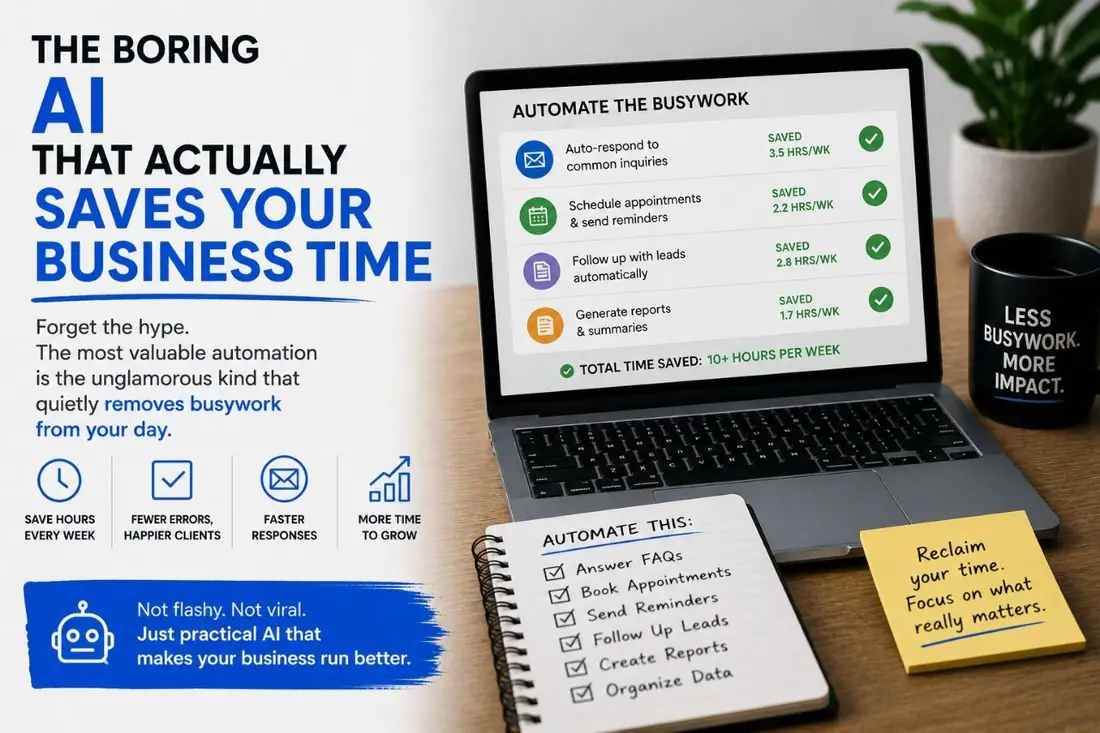
What kind of AI automations actually help a business? Unflashy ones, like automated lead follow-up, data entry, scheduling, and reporting, that quietly remove hours of manual work each week.
Do I need a big budget for useful AI? No. The highest-return automations are usually simple, targeted workflows, not expensive flagship tools.
How much time can automation realistically save? For most small teams, well-chosen automations free up ten or more hours a week.