











Every agent we talk to has the same complaint: the national portals own search, and there is no way to compete. On the broad terms — "homes for sale" — that is true. The portals have domain authority no individual agent will ever match. But that is the wrong battlefield.
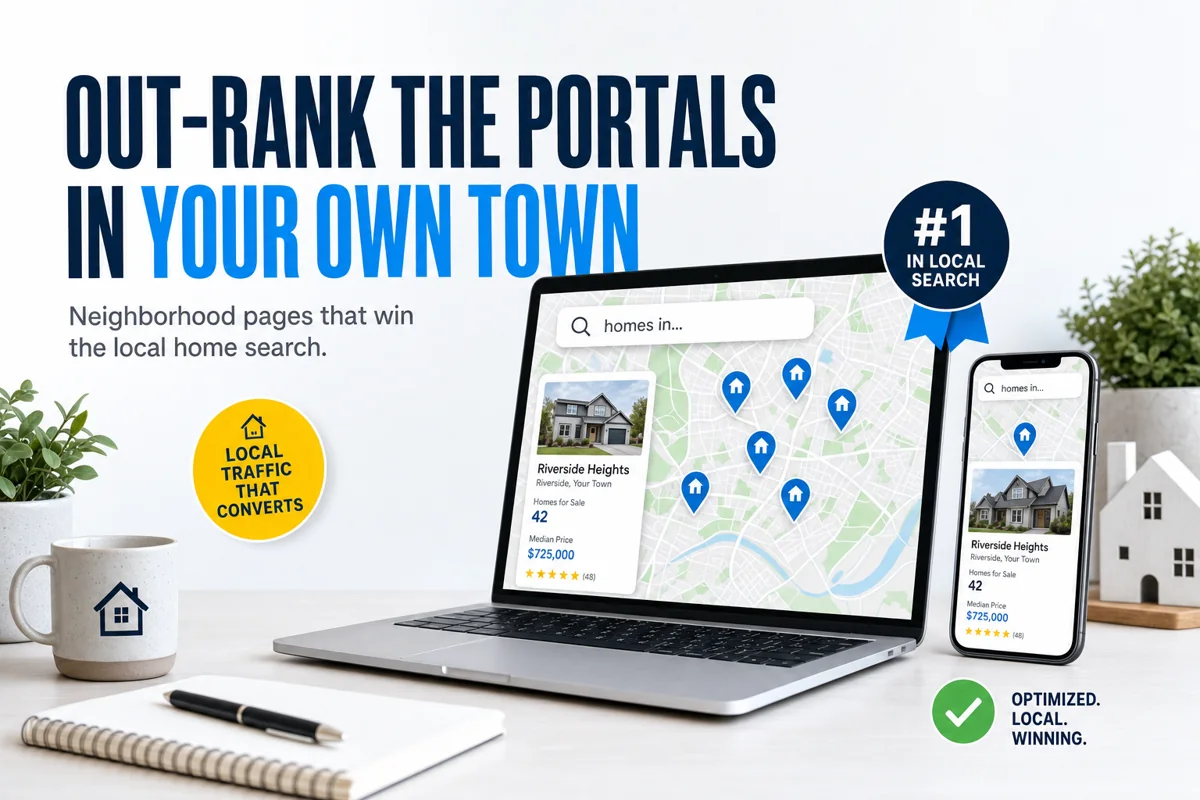
The searches that turn into clients are local and specific: "homes for sale in Maplewood", "best neighborhoods in [town] for families", "what is the commute from [suburb] to downtown". On those queries, a portal serves a generic, auto-generated page with a map and listings. An agent who actually lives and works there can publish something dramatically better — and Google rewards the better answer.
- You won't beat portals on "homes for sale" — win the local, specific, high-intent searches.
- Build one genuinely useful page per neighborhood: market data, schools, commute, lifestyle, recent sales.
- Carry Place, Breadcrumb and FAQ schema and internally link the whole set.
- A set of 10–20 pages typically pulls organic buyer inquiries within a quarter or two.
Why neighborhood pages beat agent-bio sites
Most real-estate sites are a homepage, an "about me", a contact form, and an IDX feed of every listing in the MLS. That structure ranks for nothing, because it answers no specific question. A neighborhood landing page does the opposite — it targets one place and answers everything a buyer wants to know about living there:
- Real market data — median sale price, days on market, price trends over the last year, written in plain language, updated quarterly.
- School information — district ratings, the actual schools, what locals say about them. This is the single most-searched factor for family buyers.
- Commute analysis — drive times and transit options to the nearest job centers, with real numbers.
- Lifestyle texture — the coffee shops, parks, the Saturday farmers market, the walkability. The stuff a portal's algorithm cannot write and a local agent knows by heart.
- Recent sales — specific, recent, with honest commentary on why they sold for what they did.
The structure that ranks
One genuinely useful page per neighborhood or town you serve. Each one carries the schema Google needs (Place, BreadcrumbList, and FAQ markup answering "people also ask" questions like "is [town] a good place to live"). Each links internally to your active listings in that area and to adjacent neighborhood pages, so the whole set lifts together. The goal is to become the local authority — the page a buyer bookmarks and a search engine trusts.
What this realistically achieves
Neighborhood pages will not outrank a portal for "homes for sale" nationally — nor should that be the goal. They win the long-tail, high-intent, geographically specific searches where the buyer is closest to choosing an agent. A serious set of 10 to 20 neighborhood pages, built over a few months and kept fresh, typically starts pulling organic buyer inquiries within a quarter or two — leads that arrive already trusting you, because you answered their question before you ever spoke.
The portals are renting you back your own market. Neighborhood pages are how you stop paying that rent and own the local search outright.
Common questions
Can a small agent really out-rank Zillow? Not on budget, but yes on specific local searches. A genuinely useful neighborhood page can out-rank a national portal on the queries that convert.
What makes a neighborhood landing page rank? Real local detail, market data, schools and amenities, current listings, and clear calls to action, all cleanly structured for search engines.
How many neighborhood pages should I build? One focused page per neighborhood you genuinely serve. Depth and accuracy beat a thin page for every zip code.