








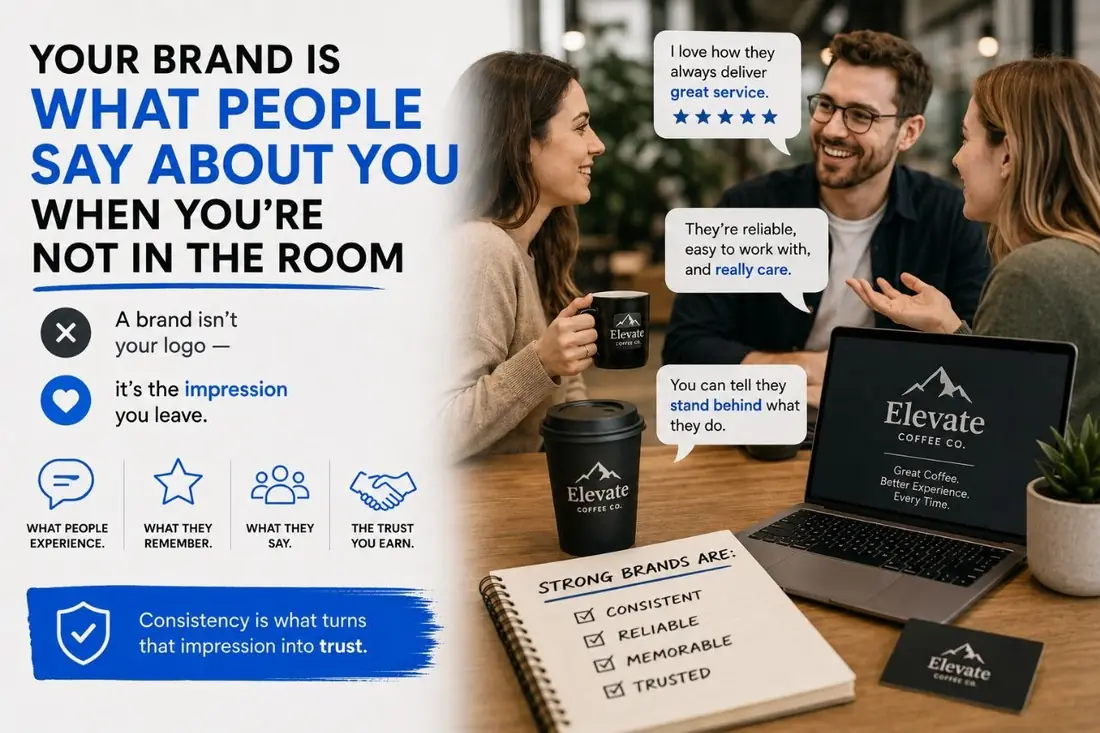
Most small businesses use "brand" and "logo" interchangeably. They are not the same thing. A logo is a mark. A brand is the entire experience of being your customer — and the gap between what your marketing promises and what your operation actually delivers is where brand reputation lives or dies.
You can spend $50,000 on a beautiful logo and still have a brand problem if your phones go to voicemail and your shipping is late. Inversely, a no-name local shop with a hand-painted sign can have a beloved brand if every customer interaction over-delivers on what they expected.
- A logo is a mark; a brand is the entire experience of being your customer.
- Brand lives in the gap between what marketing promises and what operations delivers.
- The four parts: visual identity, voice, operational experience, and recovery.
- In a crowded market, customers pick the business they trust — and trust is the output of brand.
The four parts of brand we work on with clients
1. Visual identity
Logo, color, type and photography — the recognizable surface. Important, but the easiest part and only table stakes, not the destination.
2. Voice and message
How you write and what you choose to talk about. Consistent voice across site, email, social and support is what makes a brand feel coherent instead of scattered.
3. Operational experience
Response time, delivery, packaging, the email after a purchase, what happens when something goes wrong. The largest part of brand — and no rebrand fixes failing operations.
4. Recovery
How you handle complaints, returns and mistakes. The brands customers love mess up gracefully; a great recovery can earn more loyalty than no problem at all.
The diagnostic question we ask
When NTL of NYC starts a brand engagement, we run an exercise we call "the gap map." We list, side by side:
- What your marketing currently promises (read the homepage and ad copy out loud)
- What customers actually experience (pull reviews, support tickets, repeat-purchase data)
Wherever those two columns diverge is a brand problem. Sometimes the marketing is overselling — that is a credibility leak that erodes trust over time. Sometimes the operation is over-delivering and the marketing is hiding it — that is wasted equity nobody knows about. The job is to align them.
Why this matters more than ever
In a market where every category has 50+ search results, customers do not pick the cheapest or the closest — they pick the one they trust. Trust is the cumulative output of brand. You build it by closing the gap. There is no shortcut.
Common questions
What is a brand, really? It is what your customers say about you when you are not in the room, which is the gap between what you promise and what you deliver.
How do you improve a brand? By narrowing that gap, delivering consistently on the promise and aligning your messaging, design, and experience around it.
Is a logo the same as a brand? No. A logo is an identifier. The brand is the reputation and expectation that builds up behind it.