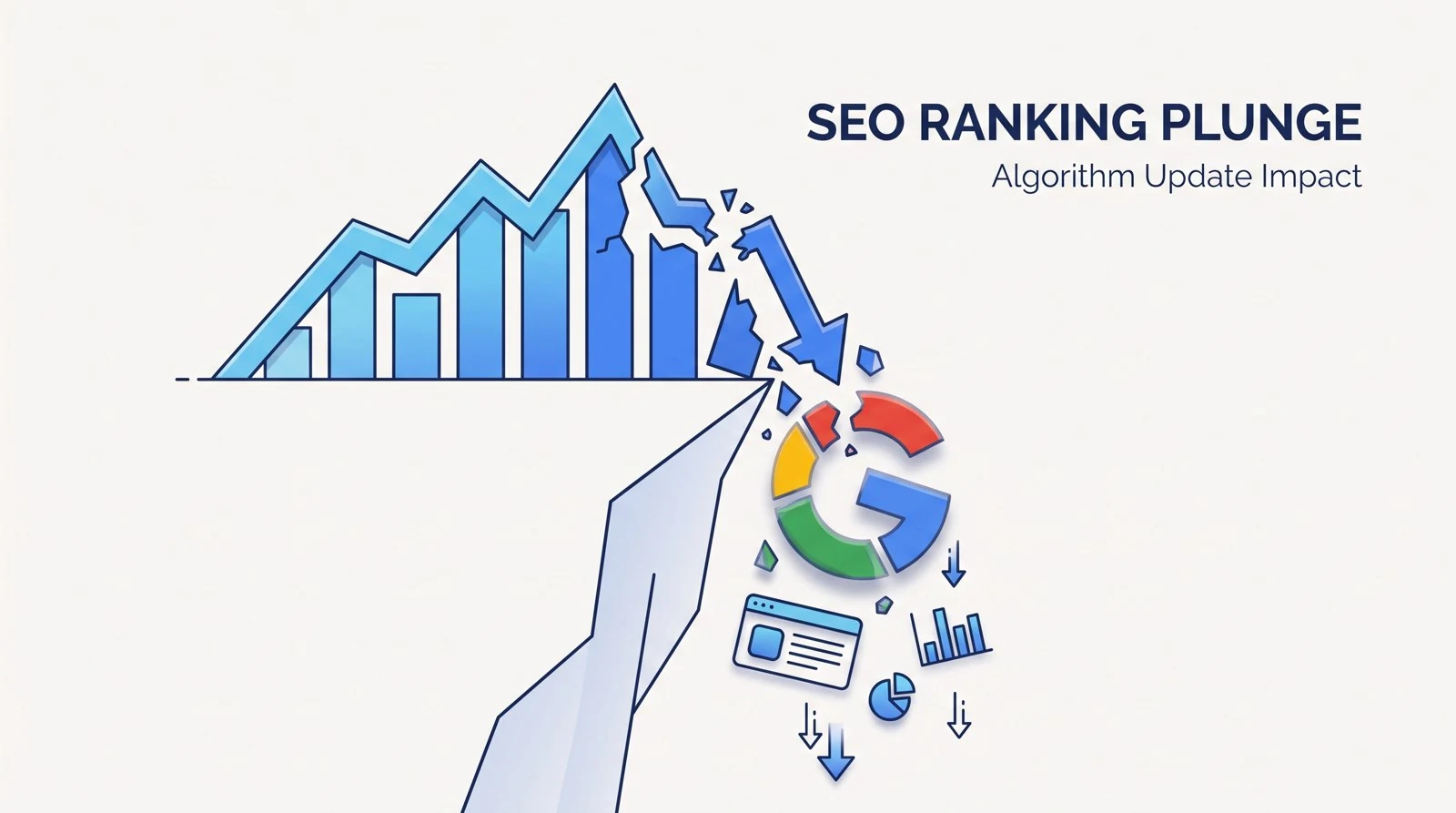









If you opened Google Search Console this week and watched months of steady growth vanish in a matter of days, take a breath. A major Google update just rolled through — and the worst thing you can do right now is panic and start ripping your site apart.
Between August 18 and August 21, 2026, Google rolled out its August 2026 Spam Update — a global change, across all languages, aimed squarely at sites that break Google’s spam policies. For a lot of site owners the result looked the same: a clean upward climb that suddenly snapped and dropped hard. Below, we’ll walk through what happened, how to tell whether it actually hit you, and the exact three-step recovery process we use.
- The August 2026 Spam Update rolled out Aug 18–21, worldwide, targeting spam-policy violations.
- Not every drop is the update — an Aug 13 Search Console reporting glitch muddied the picture.
- Don’t react mid-rollout. Rankings churn while an update is live; nothing is final until Google marks it complete.
- Recover with a calm, evidence-first sequence: confirm the timing, wait for the rollout, then audit for real quality.
What actually happened in August 2026
Three separate things collided this month, and it’s worth keeping them straight — because they don’t all call for the same response.
| When | What happened |
|---|---|
| Aug 13 | A Search Console reporting glitch. A logging error temporarily suppressed impression tracking for Generative AI search features. If your steepest “cliff” lines up with this date, part of what you saw may be a reporting issue, not a true ranking loss. Google has since fixed it. |
| Early Aug | Ranking volatility. Publishers reported fluctuations and traffic shifts at the start of the month, independent of any official core announcement — normal search “weather.” |
| Aug 18–21 | The August 2026 Spam Update. A worldwide rollout over roughly three days, targeting general spam practices across all languages. This is the one with real ranking consequences. |
Important: Don’t blame your whole drop on one cause. A dip that started around Aug 13 in AI-feature impressions may be the reporting glitch. A drop that begins around Aug 18 and holds is more likely the spam update. Separating the two is the first job — and it’s exactly where most people go wrong.
First rule: don’t panic (and don’t touch anything yet)
Here’s the honest truth about live updates: nobody knows the final outcome while a rollout is in progress. Your rankings might drop today and recover Friday. They might swing in waves for two weeks. That churn is normal — nothing is final until Google marks the update complete on its ranking-status dashboard.

Observe and diagnose — don’t react. For scale: the March update finished in a single day; the August 2025 update churned for 27 days.
If you start deleting pages and rewriting content mid-rollout, you can easily do more damage than the update itself — and you’ll never know what caused what, because Google is still measuring everything in real time. A traffic drop is emotional, and decisions made in that state are usually bad ones.
The 3-step recovery playbook
This is the same sequence we run for clients when an update hits. In order — and no skipping ahead.
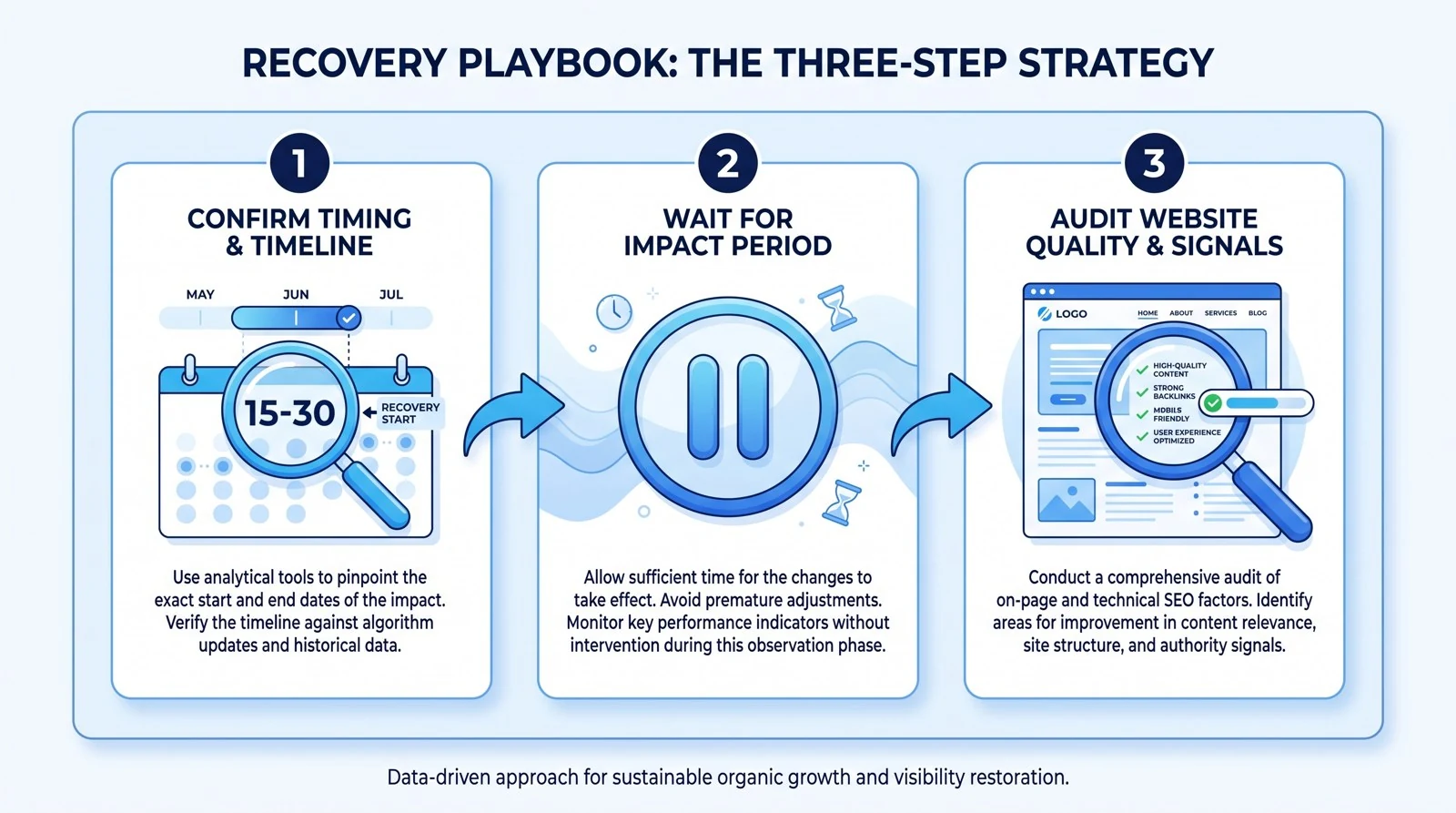
Step 1 — Confirm the timing
Open the Performance report in Google Search Console and look at clicks and impressions from August 18 onward (give it a few days — Search Console data lags). Did the drop actually start around the 18th? If your traffic was already sliding on the 10th, this update isn’t your problem, and you’d waste months fixing the wrong thing.
Then segment — don’t just stare at the total. Break it down by pages and by query. If one cluster of pages fell while everything else held, Google just told you which pages it doesn’t trust. If the whole site took the hit, the issue is more likely something site-wide.
Step 2 — Wait for the rollout to complete
Every instinct will tell you to act now. Don’t. Rankings whip around while an update is live, and Google is still measuring. Wait for the Google Search Status Dashboard to say complete — then give yourself a little more breathing room before making decisions. No mass deletions, no panic rewrites, no drastic changes mid-rollout.
Step 3 — Audit with fresh eyes
Once the rollout is done, open Google’s spam policies and walk your site one page at a time, asking a single question: “Does this page exist to help people, or to rank?”
Then apply the Marie Haynes lens: don’t just ask “Did I intend to manipulate?” — ask “Could this pattern match to manipulation?” Look hard at thin or templated pages, near-duplicate content, and anything low-value that a spam system might flag, intended or not.
The through-line: confirm it’s really you → wait for the dust to settle → fix what genuinely fails the “helps people” test. Calm, evidence-first, in that order.
What this means going forward
Spam updates aren’t punishments handed down at random — they’re Google getting sharper at rewarding content that genuinely helps people and demoting content built purely to game rankings. The sites that recover, and the sites that stay resilient through the next update, are the ones built on real quality: original, useful, trustworthy pages that answer the question a searcher actually has.
How NTL of NYC helps you recover
Diagnosing an update drop correctly — and resisting the urge to overreact — is exactly the kind of work that’s hard to do calmly when it’s your own traffic on the line. That’s where we come in.
Pinpoint the real cause
Separate a reporting glitch from a genuine ranking loss, and confirm whether the update actually hit you.
Segment the damage
Identify exactly which pages and queries lost trust, so effort goes where it counts.
Spam-policy & quality audit
Review your site against Google’s guidelines through the “helps people vs. ranks” and Marie Haynes lenses.
Build a recovery roadmap
A prioritized, evidence-based plan you execute after the rollout, not in a panic during it.
Future-proof your content
So the next update is a non-event instead of a fire drill.
Rankings dropped and not sure why? Talk to our team for a free, no-pressure review of your Search Console data — we’ll tell you honestly whether the August 2026 update hit you, and what (if anything) to do about it.
The bottom line
The August 2026 Spam Update is a reminder that search rewards trust, not tricks. Confirm whether it actually hit you, resist the urge to react while the rollout is live, and then fix what genuinely fails the “does this help people?” test. Do that, and a drop becomes a reset — the foundation for rankings that hold through the next update, not just this one.